Search This Blog

Showing posts with label kirkuk. Show all posts

Sunday, March 22, 2015

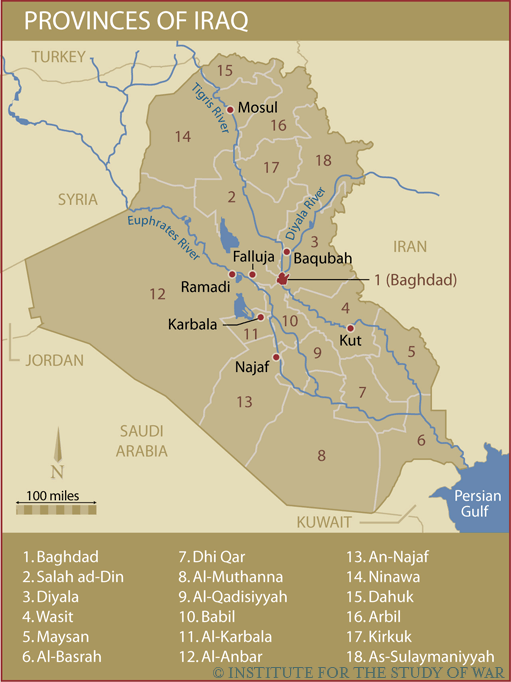
Iraq Situation Report: March 18-20, 2015

 Click for enlarged Map and PDF
1   On March 20, a Bani Qais tribal leader stated that ISIS had surrounded the Zaraa area,
south of Baiji, on four sides, threatening 300 families. Nafus called for immediate help from
the security forces. A security source stated that ISIS members were “1km” away from al-Zaraa
and threatened 200 families. ISIS had also taken “full control” of Malha village, south of Baiji.

2   On March 18, security forces began an “intensive” artillery bombardment of ISIS positions in central Tikrit. An AAH spokesperson stated that the Tikrit operation had been delayed for tactical reasons. He added that security forces had prepared to conduct the operation without civilian casualties. However, he stated that the civilians that remained in ISIS-held areas had “refused” to leave their homes.

3   On March 18, MoD stated that a force from the 5th Division and the “Popular Mobilization” cleared an nonspecific ed number of villages “towards Tuz Khurmatu,” encountering “no resistance” from ISIS members. IA Aviation destroyed seven vehicles carrying weapons and an armored vehicle. Th e 5th Division’s Engineering Unit also cleared IEDs in the area. MoD added that “many” IDP families had returned to their recaptured villages.

4   On March 19, the Golden Division supported by coalition air cover and IA conducted clearing operations in Haouz, 20th Street, Armil, Iskan, and “other” neighborhoods in Ramadi, killing 14 ISIS members. A security source coalition airstrike targeted an ISIS “den” in Tamim neighborhood in western Ramadi, killing seven ISIS members and destroying a vehicle. Coalition airstrikes also targeted ISIS in Albu Dhiab Island and destroyed a convoy of vehicles near Salim Bridge, north of Ramadi.

5   On March 19, the Anbar provincial chairman stated that “major” advances were made by “security forces” in recapturing the Jazeera
and Mamal areas, west of Garma, and Rood and Hamria areas, north of Garma. On March 20, a security source in Salah al-Din stated that a force from the 1st Rapid Response Division, “Popular Mobilization,” and tribal fighters had surrounded ISIS fighters in Garma from all sides. MoDstated that a BOC force killed 16 ISIS fighters and dismantled 117 IEDs in central and eastern Garma.

6   On March 19, MoD stated that an IA Aviation airstrike in Fallujah killed the ISIS “military planner” in Anbar province, Maher Ahsan, and two ISIS leaders in charge of rigging explosives in Fallujah. Another IA Aviation airstrike targeted an ISIS “rocket storage facility” in Saqlawiyah area, northwest of Fallujah, destroying 140 rockets and killing those inside. 

7   On March 20, ISIS members attacked on Dujila village, north of Samarra. The “Popular Mobilization” repelled the attack, killing “dozens” of ISIS members, but suff ered three killed and seven wounded.

8   On March 18, a security source in Diyala province stated that
“unidentified ed individuals” killed the head of al-Khalis Appeals Court, Samer al-Anbaki and one of his body guards as they were leaving the court building, northwest of Baqubah district. However, another security source stated that al-Anbaki was targeted while he was inside a car on the road that connects al-Khalis and Baqubah. An Anbaki tribal leader warned that his tribe will no longer allow its 3,000 tribal fighters to participate in the “Popular Mobilization” if the government does not take “urgent action.”

9   On March 19, an anonymous local source in Diyala stated that more than 40 families had been denied permission to return to their homes in villages north of Muqdadiyah district, northeast of Baqubah, on grounds that they collaborated with ISIS. More than 1,200 families have returned to 40 villages in the area north of Muqdadiyah district.

10   On March 19, unidentified ed gunmen red from a car on a checkpoint manned by police and Awakening members in Hur Rajab in southern Baghdad, killing three checkpoint personnel and
wounding six others. 
-----------------------------------------------------------------------------
Iraqi Security Forces and Iraqi Shi'a militias have begun to shell Tikrit. Shelling may disrupt ISIS within the city, making further advances to clear ISIS possible. Shelling will also likely in ict civilian casualties, which may have divisive consequences. Shelling alone will not destroy ISIS in Tikrit, nor remove its control of the city. e ISF shelled Fallujah heavily in the early months of 2014, and ISIS still remains in control of the town. ISIS attacked north and south of Tikrit on March 20, likely attempting to make gains or divert attention from ongoing operations in Tikrit. e ISIS attacks north of Tikrit were more substantial, with ISIS reportedly gaining control of new villages west of the river and immediately south of Baiji. ese ISIS positions may allow ISIS to remain active in Salah ad-Din while the battle for Tikrit unfolds, possibly renewing attacks upon Baiji from the western desert. Meanwhile, in Anbar province, elements of the Iraqi Security Forces, Shi'a militias, and the “Popular Mobilization” attacked ISIS in Ramadi and north of Fallujah. Th e reporting about these operations suggest new gains by the ISF, but not de nitive outcomes to clear ISIS from them. Both ISIS and anti-ISIS forces are active in Salah ad-Din
and Anbar simultaneously

Insights about Media/News Sources in Iraq and Iraqi Kurdistan


Research by Broadcasting Board of Governors

Iraq boasts the fourth-largest population of any Arab country (after Egypt, Algeria, and Morocco), and one of the most robust domestic news media markets in the region. With dozens of daily newspapers, radio stations, and TV channels serving the country and home satellite service ubiquitous, most Iraqis and Kurds have a wide range of news options. The fall of Saddam Hussein in
2003 swept away the strict government control over Iraq’s media and ushered in an era of extreme media pluralism, with groups all over the country starting hundreds of newspapers and dozens of radio and television stations. However, ongoing sectarian conflict and political control of many Iraqi media organizations hampers the population’s access to reliable, objective news content.

General Media Environment
As in much of the Arab World, satellite TV is almost ubiquitous in Iraq, present in 97.3% of households (versus 35.1% with radio and 50.4% with the Internet). Ethnic Kurds and those with a college degree are much more likely than other Iraqis to have Internet access at home; those living in Anbar province are less likely than average to have it (21.9%), as are Iraqis with only some intermediate education or less (37.7%). More than nine in 10 Iraqis (92.2%) have their own mobile phone, and 35% have accessed the Internet via mobile device in the past week.

The ongoing conflict has displaced many residents and has hindered their access to TV, radio, and the Internet. More than one-quarter (27.0%) of Iraqis say that they have been “displaced” in the past 12 months due to instability, with larger percentages displaced in ISILcontrolled areas of Anbar and Ninevah and in the disputed area of Salah ad-Din. The instability has disrupted many Iraqis’ access to TV and Internet, in particular, with 31.5% saying instability is hindering their access to TV frequently (12.0%) or occasionally (19.5%); 38% say it is hindering their access to the Internet frequently (19.9%) or occasionally (18.3%) and 15% say it is hindering their access to radio frequently (4.9%) or occasionally (10.1%); Despite the disruptions, Iraqis and Iraqi Kurds remain
frequent news consumers. Half of the respondents to this survey (49.5%) reported following current events in the country “a lot,” while an additional 21.5% follow them “somewhat.” The vast majority of Iraqis (82.8%) indicate they access some type of news at least daily, and a similar proportion (80.3%) say they discuss or share news with others weekly. Most Iraqis (57.0%) access news and share it with others every day. Weekly users of international news media are even more likely to access and share news daily. Trust in news media varies significantly across regions in Iraq. During the survey period, the country was in the grip of a major conflict between central government and
Kurdish forces on one side and ISIL on the other, with ISIL in control of the predominantly Sunni Arab provinces of Anbar and Ninewa, and vying for control of Salah ad-Din, Diyala and the mixed-ethnicity province of Kirkuk. Iraqis living in the predominantly Sunni Arab provinces are more likely to “strongly distrust” news from television or radio than those living in areas consisting mostly of Shia Arabs or Kurds. Those in ISIL-controlled, predominantly Sunni, areas were also more likely to
“strongly trust” news from the Internet than Iraqis in other regions.

Television
TV is the primary source of news in the country with more than nine in 10 (92.1%) adults saying they watch TV news at least weekly. Friends and family is the only other source from which a majority of Iraqis (72.6%) get news weekly or more. About one-third get news from the Internet, social networking sites and text messages at least weekly, while only about one in five Iraqis gets news from radio or print media that often. While the three most popular TV stations nationally in terms of past-week reach are Al Iraqiya (68.8%), Al Sharqiya (65.2%), and Al Sumeria (58.1%), politics and
sect strongly affect TV viewership. Second place Al Sharqiya TV, as well as other top Sunni-oriented
channels Baghdadia TV and Al Arabiya do much better in the ISIL-controlled and disputed areas, which have much higher proportions of Sunni Arabs. Sunni Iraqis have frequently criticized Al Iraqiya, for example, as being biased against them and/or overly friendly to the Shia-led government.

Radio
About one-fourth of respondents (27.7%) report listening to the radio in the past week and 19.7% of Iraqis use it weekly for news. Weekly radio use is most common among men, better-educated Iraqis and Kurds. Most past-week listeners (69.4%) say they tune in via FM, though one in five (20.8%) use AM and 15.4% use shortwave. Those living in the predominantly Shia Arab provinces south of Baghdad are particularly likely to use shortwave on a weekly basis, at 23.0%.

Mobile Phones
Virtually all adults (92.2%) own a mobile phone, and about one-third of the population (34.1%) has used a mobile phone to access the Internet in the past week — almost as many as say they accessed the Internet in the past week at all during that time. Three in 10 mobile phone owners say they have used a mobile phone to download video or audio clips or access social networking sites. More than 25% say they downloaded or used a mobile app in the past week, while only 16.3% say they used a phone to listen to the radio in that time. Men, young adults and the collegeeducated are particularly likely to use mobile phones for all of these activities, except listening to the radio, which skews significantly toward young people alone.

Internet
Two in five (40.3%) adults report having accessed the Internet in the past week. That figure rises to about half among Iraqi men, Kurds and those aged 15 to 24, and more than three-fourths among Iraqis with a college level education. Internet users are heavy video consumers. Three-fourths
of weekly Internet users (73.9%) went online to view videos such as TV programs, news reports, video clips, sports or movies. In contrast, 63.3% went online to find out the latest news and 58.1% did so to access audio news reports, music or radio programs. Weekly Internet users aged 15 to 24 are particularly likely to have watched online videos, at 80.1%. Those with a college education are more likely to have gone online to search for the latest news (75.7%) than are weekly Internet users with less than intermediate education (51.5%). Men, young adults and the better educated are most likely to get news online. Similarly, Kurds are much more likely than Arabs or other Iraqi ethnic groups to access news on the Internet, whether through social networking sites or other websites. Men are also more likely than women to listen to radio news at least weekly. Most of Iraq’s weekly Internet users consume online content in Arabic only. Even Kurdish Iraqis more commonly use content in Arabic (74.1%) than in Kurdish (60.5%). Overall, only 4.9% of past-week Iraqi Internet users do not use Arabic content.

Social Media
Three in 10 respondents report using social networking sites at least weekly. Among those with at least some college education that figure rises to about two-thirds (65.5%); men, younger adults and Kurdish Iraqis are also particularly likely to use social networks weekly or more. Facebook is by far the most popular social networking site, with almost all past-week social media users (94.3%) having accessed it in the past seven days. The next most popular are Google+ at 41.8% and
Twitter at 25.8%.

Methodology
This data is based on 2,735 landline and mobile telephone interviews with adults aged 15 and older living in Iraq with access to a landline or mobile telephone. Trained interviewers conducted the fieldwork Oct. 18 – Dec. 2, 2014, in Arabic and Kurdish with Iraqi adults in all 18 provinces. Results represent approximately 20,245,0001 adults living across Iraq and Iraqi Kurdistan. Researchers stratified the target population by governorate. Out of a total sample of 2,735 interviews, researchers
proportionally distributed 2,015 across all 18 governorates. Researchers conducted an oversample of
720 interviews in the three governorates where the majority of the Kurdish population lives — Sulaymaniya, Arbil and Dahuk — to ensure at least 1,000 interviews with Kurdish respondents, Researchers weighted all post-stratification results by age, gender and education.

Contact
For any questions or further information on this data, please contact the Broadcasting Board of Governors at publicaffairs@bbg.gov or 202-203-4400. Follow us on twitter at @BBGgov 

Wednesday, March 18, 2015

In northern Iraq, casualties as Kurds push back Islamic State (+video)


Backed by US-led airstrikes, Kurdish fighters are pushing south of the Iraqi city of Kirkuk into territory held by the self-proclaimed Islamic State, underscoring new momentum in the fight. 

  • View Caption
Bulldozers with steel plates welded over their cockpits to thwart snipers are digging earth berms and trenches here, creating the new front lines of northern Iraq
Kurdish peshmerga units began a week ago pushing beyond a line 20 miles southwest of the oil city of Kirkuk, which Kurds have held since last summer when Sunni militants swept into Iraq from Syria. The Kurdish fighters' aim is to squeeze the self-styled Islamic State between them and a parallel offensive by the Iraqi Army and allied Shiite militia to the south that has encircled Tikrit.
The multi-pronged fight is a major test for reconstituted Iraqi forces. When IS jihadists seized the northern city of Mosul last year, entire Iraqi Army divisions disintegrated. Today, the momentum appears to have shifted: US officials estimate that IS today has lost 25 percent of the territory—nearly 5,000 square miles—it held at its peak last August, when it declared an Islamic caliphate.
Recommended: How much do you know about US-Iraq relations? Take our quiz.
Kurdish forces, aided by US-led airstrikes, say they are making far faster progress than they expected – up to 15 miles in some places – across the flat ground carpeted with spring green. They've been capturing villages laced with booby-traps and car bombs.
 “They are fighting hard and have readiness. We have martyrs and wounded, and this is a real sign,” says Wasta Rasul, the Kurdish commander of southern operations. IS forces “are retreating and they are not the same IS they used to be. I think in the next few days IS will not exist in the Kirkuk area.”
The Kurds want to push IS out of artillery range of oil and gas installations here, and squeeze them between Tikrit and Kirkuk. Using binoculars and targeting scopes from the top of the freshly dug earth berms, Kurdish fighters watch the nearby village of Tal al-Ward. Wounded peshmerga from the fight—some of them screaming—are driven quickly by in the back of trucks.
About 50 wounded are brought to Kirkuk hospital by dusk on this day alone, and an unspecified number of dead. One Humveelimps by, bulletproof windows impacted by rifle shots, tires shredded by a roadside bomb. Another Humvee is towed, its tire rubber flapping uselessly in the dirt. The sound of US warplanes circling high above lasts for hours.
“If the airplanes don’t support us, we can’t advance,” says one Kurdish fighter, sharing a common refrain. “They are retreating...we are weakening them,” says Lt. Col. Bakr Ahmad, who juggles a radio and mobile phone, and is tasked with calling in coalition airstrikes. “We don’t forget the role of the alliance—those planes make a big difference,” he says. “When I need them I ask and they do it.”

From a state to a terror group

Last summer Kurdish fighters set up defensive lines southwest of the strategic oil town of Kirkuk, near the Lower Zab canal. Eight months ago “[IS] were attacking us, now we are attacking them,” Fuad Hussein, chief of staff to the president of the Kurdistan Regional Government, told a forum held last week in northern city of Sulaymaniyah. “If the strategy is to weaken them, they are weaker. If the strategy is to turn them from a state to [only] a terrorist organization, we are on the path.”
Yet without defeating IS in Syria, warns Mr. Hussein, the jihadis will keep coming back to Iraq. Already some 20,000 foreign fighters from 90 different countries have joined IS in Syria and Iraq, “many of them" seeking suicide operations, said Brett McGurk, the US Deputy Assistant Secretary for Iran and Iraq, speaking at the same forum. The map of anti-IS forces advances show “how the tide is slowly starting to turn.”
Kurdish forces have a “very solid defense line” and US-led airstrikes give “great confidence” to the peshmerga as they advance, agrees Michael Knights of the Washington Institute for Near East Policy.
Yet IS remains potent, despite an estimated death toll from US-led airstrikes of 6,000, as of a few months ago. Within a week recently the group launched 10 major attacks with 100 to 200 fighters each. Each attack formation was decimated by airstrikes and ground forces. “The refreshment of this movement is higher than anyone thinks, and as a result there is no military solution," warns Mr. Knights. 

Secret tunnels and suicide attacks

IS has a few tricks up its military sleeve. Several bodies still rot amid the rubble of Dur al-Kahraba village, which Kurds took control of last week. Three houses down from a small mosque the Kurds found a surprise: an 8-by-8-foot hole dug in the living room of a house that leads into a 150-yard-tunnel that nearly reaches Kurdish trenches. All other rooms were full of dirt, in a bid to hide the excavation from view.
“This is IS, this is how they were thinking,” says Shukur Abbas, who in charge of the bulldozers building trenches and flattening recaptured villages. 
At night in Kirkuk at the hospital, the emergency entrance is a constant hive of activity, as casualties are driven in and relatives arrive, often in tears. 
Fadhil “Hama Jaff” was wounded in the blast of a suicide car bomb, as his Kurdish unit—buoyed by days of swift progress—attacked an IS-controlled village that morning. “They were fighting hard,” says Mr. Fadhil, speaking from his hospital bed. “All at once they stopped shooting at us, we thought they were retreating. We advanced and they sent an SUV—we were surprised.”
Another Kurdish fighter, Bakhtiar Jabar, jumped out of the Humvee and fired his heavy machine gun at the oncoming vehicle, but it was armored and the bullets had no effect.
Mr. Jabar was struck with shrapnel in his side, and that night in the intensive care ward said repeatedly: “I am in pain. I am in pain.” Such events are no surprise to commander Rasul. “Scientifically, I haven’t seen anything special about their [IS] fighting ability,” he says. “They are here only for suicide.”
Kurdish forces retake Kirkuk villages after eight-months of IS control
Reuters

Saturday, February 21, 2015

Muslims Condemn ISIS around the World !!

Muslims Condemn ISIS actions and declare ISIS are not true Muslims, ISIS are barbarians.
Around the World Muslims have protested and condemned the #ISIS / #ISIL / #Daeshbags atrocities, #Daesh is an abomination. Currently they control #Mosul in #Iraq and #Raqqa in #Syria. Their Defeat in #Kobane in Northern Syria finally has #ISIL on the run. The #Kurdish #Peshmerga have done an amazing job of pushing #ISIS out of Kobane and they are now pushing them all the way back to #Raqqa. The #Kurds in Iraq have #Mosul surrounded on 3 sides and are ready to oust them from #Iraq. But we are still waiting on the #Iraqi army. I expect the Iraqi Army will approach Mosul from the South or Southeast of Mosul. This should start in about a month but may take 2 months till the big battle for Mosul Starts. The #deashbags in MOsul have told the citizens in Mosul that they must give them one boy from each family to help #ISIS in the fight. Lets hope these unwilling recruits will turn their guns on #ISIL. I hope that we wil see what happened in Baquba in 2007 when the citizens helped point out where the terrorists were hiding.


Friday, February 20, 2015

Counterinsurgency Expert Dr. David Kilcullen talks about ISIS in Iraq and Syria 2015


DavidKilcullen.jpgMost recent one hour lecture by Dr. David Kicullen talking about counterinsurgency and how to defeat ISIL / Daesh / ISIS / Islamic State in Iraq and Syria and elsewhere. David John Kilcullen FRGS (born 1967) is an Australian author, strategist and counterinsurgency expert and is currently the non-executive Chairman of Caerus Associates, a strategy and design consulting firm that he founded.[2] From 2005 to 2006, he was Chief Strategist in the Office of the Coordinator for Counterterrorism at the U.S. State Department.[3]


Kilcullen was a senior counter-insurgency advisor to General David Petraeus in 2007 and 2008, where he helped design and monitor the Iraq War troop surge.[4] He was then a special advisor for counter-insurgency to Secretary of State Condoleezza Rice.[5] Kilcullen has been a Senior Fellow of the Center for a New American Security[6] and an Adjunct Professor at the Paul H. Nitze School of Advanced International Studies at Johns Hopkins University.[7] He has written three books: The Accidental GuerrillaCounterinsurgency, and Out of the Mountains.[8]

Tuesday, February 17, 2015

ISIS threatens to burn children alive in a cage


   Bookmark and Share  
  • isis-burning-children.jpg
isis-burning-children.jpg
A picture posted by Pegida on Twitter shows children gathered and locked into a cage, and a someone holding a lit torch. 

The source of the picture is not known or verified but the children are wearing the same orange jump suits as previous victims of ISIS' horrific execution methods.

Not long ago a Jordanian pilot was burned alive in a cage by ISIS, which triggered the Jordanian king to react and issue the following statement before bombing the crap out of the terrorist organization in Syria:

"Any son of a bitch takes a shot at me, I'm not only going to kill him, I'm going to kill his wife and all his friends and burn his damn house down."


Earlier this week, harrowing pictures emerged which appear to show captured Kurdish fighters paraded in cages by Daesh terrorists through the streets of Kirkuk, Iraq.

Now Daesh even plans to burn children alive.

Monday, February 16, 2015

Iraq Crisis Situation Report No.31 (7 - 13 February 2015)

Highlights
 ISIL seizes large parts of al-Baghdadi
 WFP begins food distributions in Zummar and AlQuosh;
assessments ongoing
 In Erbil, 1,000 IDPs at Debagah site in need of
WASH assistance
 Situation in Kirkuk remains tense. Aid agencies
operate with caution
 Further support for Al-Wand IDP camp needed
(Diyala)

Situation Overview
No new displacement has been reported in Anbar Governorate after fighters belonging to the Islamic State of Iraq
and the Levant (ISIL) seized large parts of the western town of al-Baghdadi on 12 February, threatening an
airbase where US soldiers are training Iraqi troops, about 85 km northwest of Ramadi. ISIL attacked al-Baghdadi
from two directions before advancing on the town. Until its fall, al-Baghdadi was one of the few towns in western
Anbar still held by the Iraqi army.
Families are reportedly too afraid to flee until clashes calm down before moving to another location, the
International Organization for Migration (IOM) reported, which continues to monitor the situation. According to the
latest IOM Displacement Tracking Matrix, there are currently 373,302 people displaced within Anbar Governorate
(as of 29 January 2015). For months, ISIL had surrounded the town’s parameter preventing much needed
humanitarian assistance of reaching residents, local aid workers confirm. ISIL is reportedly preventing residents
from leaving the city.
The World Food Programme (WFP) has started food distribution through partners in Zummar and Al-Quosh
(Ninewa Governorate). There remains an information gap on returnee population and associated protection
concerns. Partners from the food security cluster are undertaking assessments in newly accessible areas,
including around 15-17 villages in Ninewa Governorate. A handful of partners have been already begun working
in four areas of Ninewa. OCHA is supporting agencies by negotiating and advocating for easy access to the
recovered areas through authorities from Ninewa.
An NGO Consortium has started the Camp Management Project, which will cover 11 out of 14 open camps in
Dahuk. Support will be provided in three areas of camp management – protection, community participation and
information management.
Map Source(s): CODs. The boundaries and names shown and the
designations used on this map do not imply official endorsement or
acceptance by the United Nations. Map created on 15 February 2015.

CLICK HERE FOR THE PDF DOWNLOAD OF THE ENTIRE DOCUMENT

Tuesday, December 18, 2007

Turkey's Air Stikes in Iraq

I have included some mainstream media Links and excerpts below. For a brief background on the problem one must look back in history.

History - Ancient period

Recognition of the existence of a Kurdish land goes back even as far as Sumerian Cuneiform Tablets, dating from about 3000 BC, which speak of the land of the Kurds.[10]

Much of Kurdistan corresponds roughly with the ancient Kingdom of Gutium (Qurti), which is mentioned in cuneiform records about 2400 BC, and had its capital at Arraphkha (modern Kirkuk).[11] (wikipedia)

Modern period

In the 16th century, the Kurdish-inhabited areas were split between Safavid Iran and the Ottoman Empire after prolonged wars. The first important division of Kurdistan occurred in the aftermath of the Battle of Chaldiran in 1514. This division was formalized in the Treaty of Zuhab in 1639.[17] Before World War I, most Kurds lived within the boundaries of the Ottoman Empire in the province of Kurdistan. After the collapse of the Ottoman Empire, the Allies agreed and planned to create several countries within its former boundaries. Originally Kurdistan, along with Armenia, was to be one of them, according to the never-ratified Treaty of Sèvres. However, the reconquest of these areas by Kemal Atatürk and other pressing issues caused the Allies to accept the renegotiated Treaty of Lausanne, accepting the border of the modern Republic of Turkey and leaving the Kurds without a self-ruled region. Other Kurdish areas were assigned to the new British and French mandated states of Iraq and Syria under both treaties.

The Kurdish delegation made a proposal at the San Francisco Peace Conference in 1945, showing the geographical extent of Kurdistan as claimed by the Kurds. This proposal encompasses an area extending from the Mediterranean shores near Adana to the shores of the Persian Gulf near Bushehr, and it includes the Lur inhabited areas of southern Zagros.[18][19]

Since World War I, Kurdistan has been divided between several states, in each of which Kurds are minorities. At the end of the First Gulf War, the Allies established a safe haven in northern Iraq. Amid the withdrawal of Iraqi forces from three northern provinces, Iraqi Kurdistan emerged as an autonomous entity inside Iraq, with its own local government and parliament in 1992.

Current Events

Given the historical events it is likely there are many (including me) who are sympathetic to the thought of a re-united Kurdish Nation. Yet one must concede that in present time this would create a weakened Iraq and unstable environment in Turkey and the region. Also the PKK has been identified as a militant terrorist organization, not a political movement. It is the action the PKK uses that gives it this designation as a terrorist organization. Therefore we are not likely to see anyone other than the PKK backing any such military moves.

The only way a re-united Kurdistan could occur is through a politic movement, not a military one. The main host countries that now occupy once Kurdish lands include Syria, Iran, and Turkey. These host countries are not likely to give up valuable lands of strategic economic and political importance. Some estimates I have read estimate approximately 75% of the Kurdish population in the host countries live not in the Kurdish areas, but rather in the cities and capitals of the host countries. - Ian Bach

Turkey's air strikes in Iraq Kurdish Areas.

Time Magazine writes:
(by Andrew Purvis)

"The official U.S. line is that Washington did not approve Turkey's Sunday air strike on Kurdish targets in northern Iraq. But the U.S. does control the skies over Iraq and the Pentagon did open airspace over Iraq for at least three hours to Turkish warplanes. It was also informed of the raids beforehand, according to an American spokesperson in Ankara. "By opening its airspace, America gave its approval to the operation," Turkish General Yasar Buyukanit said"……..(Click here for the entire article)

“The Turkish government had been threatening to send its own troops across the border to crack down on PKK bases inside Iraq since last October's attacks on Turkish troops. Washington and Baghdad at the time urged restraint, fearing that a large-scale incursion into Iraq by Turkish troops would trigger a broader clash not with the PKK but with soldiers under the command of the Iraqi Kurdish administration, thus destabilizing the one part of Iraq that has managed to avoid civil conflict so far.”

“The PKK has been waging a separatist campaign against Turkish security forces since the 1970s, most recently attacking Turkish targets from bases within Iraq. On Sunday, the PKK said five of its militants were killed; according to Iraqi officials, at least one woman civilian was killed as well. Meanwhile, hundreds have been forced to flee their homes.”