Search This Blog

Showing posts with label #fsa. Show all posts

Monday, March 2, 2015

Rebels in Syrian reject envoy plan to cease-fire in Aleppo Syria

Rebels in Syrian with the FSA and other rebel groups have rejected envoy plan to freeze Aleppo fighting.

Military and political opposition forces in Aleppo on Sunday rejected U.N. envoy Staffan de Mistura’s proposal for a freeze in fighting in the divided northern Syrian city.
“We refuse to meet with Mr. Staffan de Mistura if it is not on the basis of a comprehensive solution to Syria’s drama through the exit of (President) Bashar al-Assad and his chief of staff, and the prosecution of war criminals,” The commission of Aleppo revolutionary forces was set up on Saturday at a meeting in the Turkish border town of Kilis attended by exiled coalition chief Khaled Khoja, other opposition figures and Aleppo civil society representatives.
De Mistura’s proposal “falls short of an initiative to resolve the humanitarian crisis of our people targeted by the regime’s use of chemical weapons and barrel bombs prohibited by the international community,” it said in a statement.
Aleppo’s opposition forces also turned down preferential treatment for their region over other areas of Syria stricken by the country’s deadly conflict since 2011. “Syria and its people are one and indivisible. The blood of our brothers in Daraa (in the south), in Ghouta (near Damascus), in Homs (central) and in other Syrian provinces are no less important than our blood in Aleppo,” they said in a statement.
De Mistura on Saturday held talks in the Syrian capital to try to finalize a deal to freeze fighting in the war-ravaged second city of Aleppo. He met Foreign Minister Walid Muallem and agreed to send a delegation from his Damascus office to Aleppo on a fact-finding mission, state news agency SANA said, without giving a date.
“The mission will aim to assess the situation on the ground and to ensure that, once the freeze is announced, humanitarian aid can significantly increase and to prepare arrangements to follow up on violations of the freeze,” the U.N. said.
The Swedish-Italian diplomat “hopes to set in motion as soon as possible his project” to halt fighting in Aleppo for six weeks, said a member of his delegation.
He has met government officials and opposition chiefs in recent weeks to promote his plan for a temporary truce in Aleppo in order to move aid into the northern city.
However, de Mistura, who has made an Aleppo freeze the centerpiece of his mediation efforts since he was named last July to the post of special envoy to Syria, incurred the wrath of the opposition last month by describing Assad as “part of the solution” to the conflict.
Once Syria’s commercial hub, Aleppo has been devastated by fighting that began in mid-2012, and the city is now split between loyalist forces and rebels.
About 220,000 people have been killed in Syria since its conflict began in March 2011 with anti-government protests that spiraled into a multisided civil war drawing foreign jihadis.

FSA group Hazzm disbands US TOW missiles now in Jihadists hands

U.S.-backed Syria rebel group dissolves itself after losses


Western-backed rebel group announced on Sunday that it had dissolved itself and joined a larger Islamist alliance, weeks into a battle which saw it lose ground and men to more powerful al Qaeda Nusra Front insurgents.  The group was called Hazzm and is one of the last non-jihadist rebel groups in northeastern Syria who are opposed to President Bashar al-Assad. Much of northwestern Syria has been seized by the Nusra Front and Islamic State, an offshoot of al Qaeda that controls roughly a third of Syria.

The statement posted online by Hazzm said its fighters would join the Shamiyah Front (Levant Front), an alliance of Islamist brigades in Aleppo, to prevent further bloodshed, between rebel groups. The decision came after heavy fighting this past weekend between Hazzm and the Nusra Front, al Qaeda's official Syria wing. Hazzm is one of Obama's so called moderate rebel groups known as the Free Syrian Army or FSA. 

Hazzm had received substantial amounts of military aid from foreign states opposed to Assad, including U.S.-made anti-tank missiles known as TOW's. But it has lost ground to better armed and financed jihadists, like al Nusra Front.

On Saturday, the Nusra Front drove Hazzm out of a strategic northern Regiment 46 base in Aleppo province and killed around 30 of its fighters. 

The United Nations peace mediator Staffan de Mistura met with Syrian officials on Saturday and Sunday to discuss a freeze in the fighting in Aleppo. De Mistura said Syria has ready to halt all aerial and artillery bombing in the city for six weeks. Damascus will announce the start date of the local ceasefire. His office said on Sunday a mission has been sent to Aleppo to ensure humanitarian aid could increase significantly, and to monitor any violation of the freeze. However we have already heard from rebel groups who say they will not honor the ceasefire.

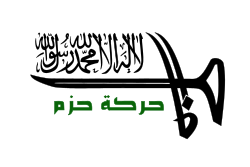
The Hazzm Movement (Arabicحركة حزم‎, Harakat Hazzm, meaning Movement of Steadfastness[3]) was an alliance of moderate Syrian rebels.[1] The group has been supplied BGM-71 TOW anti-tank missiles[12] in a covert CIA program launched in 2014, scores of the groups fighters also received U.S. military training in Qatar under the same program.[13]
Some of the groups currently involved in the alliance were part of the Farouq Brigades.[12] The groups that became the Army of Mujahedeen were originally going to join the Hazzm Movement.[14] The previous incarnation of the group, called Harakat Zaman Mohamed (The movement of the time of Muhammad), was supported by the Syrian Muslim Brotherhood.[14]
In October 2014, Al-Nusra Front began attacking positions of Hazzm in Idlib Province, overrunning bases and seizing weapon stores, due to it's perceived closeness to the United States.[13] Following the loss of men and weapons to Nusra, the Idlib branch of Hazzm stopped receiving funds from the CIA in December 2014, funds to the Aleppo branch continued.[15] In January 2015, Al Nusra attacked Hazzm Movement positions in Aleppo province. The Hazzm Movement reacted by joining the Levant Front, a large alliance of prominent Aleppo-based Islamist rebel groups; the alliance urged al Nusra to resolve its dispute with the Hazzm Movement by negotiating with the Levant Front.[16]
On 1 March 2015, after several heavy clashes with the Al-Nusra Front, the Hazzm Movement announced they were dissolving and joining the Levant Front.[2]

Wednesday, February 25, 2015

DR. SOROS: OR HOW I LEARNED TO STOP WORRYING AND LOVE MY BARREL BOMBS Read more at http://www.syrianperspective.com/2015/02/dr-soros-or-how-i-learned-to-stop-worrying-and-love-my-barrel-bombs.html#QF1M0vhrVp7XQmqU.99


The whole plan, you see, is to try to get the Syrian military to stop killing terrorists supported by Human Rights Watch and its principals.  Of course, that’s not going to happen any time soon.  Moreover, it is my fervent hope that more of these barrel bombs are dropped over the heads of the Alqaeda and ISIS rats sent to Syria by HRW’s favorite champions: the United States, Britain and Saudi Arabia.  The United States, you ask?  HRW is based in New York City and, like SOHR, is an arm of not only the Soros Open Society Foundation and the Arabian monkeys, but, also of the CIA.  Whenever HRW says anything about Syria, prepare for something – the Brits or the Americans are cooking up something – and it’s always noisome and malicious, hence the Persian expression: بوي بريطانيائي  or “it smells of British”.  HRW is our parakeet in the mines.  It warns you when the imbeciles at Langley or Vauxhall Cross are about to fly a kite to see how far it will go.
Think also of Stefant DeMistura’s plot to engineer a “freeze” in the fighting in Aleppo to give the terrorist rodents a chance to regroup, resupply and recharge themselves.  It may even be his plan to offer them safe passage toward their beloved Recep Tayyip Erdoghan, who, with a new American commitment to build up a “moderate” Syrian military force in Turkey, Jordan, Saudi Arabia and Qatar (oh, will the Saints protect us?), is now on the team dedicated to increasing the internal destruction of Syria.  The U.N. is in on the plan and Dr. Assad knows it.
Our barrel bombs are a thing of beauty.  Incredibly accurate despite what the liars at HRW and AI say.  The fins you see on the body of the cylinders are intended to give the projectiles stability to insure precise placement.  Our bombs are filled with all the ingredients necessary to send the enemy straight to the bowels of Hades without the need for medical intervention.  The ball bearings, nails, dross, bullet jackets, among other tiny objects, are meant to penetrate the skulls of vermin no matter how thick their crania may be.  Designed like a sleek, but somewhat crude, rocket, they are dropped very accurately over the exact place where our intelligence sources tell us the vultures are hiding.  They are dropped mostly by Hind helicopters which hover at sufficiently high altitudes to completely conceal their presence – to muffle the sound of the rotors mercifully holding up our heroic soldiers as they perform their solemn duties in killing pests.
The sound of a barrel bomb swishing through the air only to ignite when it touches the earth must be tantamount to a symphony by Shostakovich, rich in texture but with an explosive coda or finish. I can hear the tympani drums rolling amidst a soaring chorus of horns, brass and strings.  It is, indeed, a thing of beauty.

  Shostakovich seen here contemplating his unfinished symphony: “Barrel Bomb Symphony Number 7 in D Minor”.

Some might argue that HRW is merely trying to rebut Dr. Assad’s recent assertion that the Syrian military does not use barrel bombs, and, in so doing, cast doubt upon his credibility.  But, if that were so, it doesn’t absolve HRW of the accusation that it works for dark and insidious forces.  However, let us tell the world, the SAA does not use “barrel bombs”.  They are not called barrel bombs in Syria!  They are referred to in Arabic as “vertical bombs” which is why Dr. Assad told Jeremy Bowen of the BBC, during a typically inane interview, that he did not believe the military used “barrel bombs”.  So much for HRW and the BBC, for that matter.
So, in closing, let me once again reiterate my affection for the “vertical bomb”.  Each time it is dropped over the heads of vermin, let a clergyman, of whatever faith,  bless it and infuse it with accuracy, sanctity and lethality.  May the terrorists rest in the Inferno.

Read more at http://www.syrianperspective.com/2015/02/dr-soros-or-how-i-learned-to-stop-worrying-and-love-my-barrel-bombs.html#QF1M0vhrVp7XQmqU.99

Wednesday, February 11, 2015

ISIS Barbarians Face Their Own Internal Reign of Terror

The internal bloodletting among ISIS factions has begun, and could get much worse.
The propagandists of the putative Islamic State would have you believe it is just one big happy family, righteously slaughtering apostates, enslaving women (literally), beheading and burning alive its prisoners, all in the name of God. But quarrels over a range of issues—from divvying up of the spoils of war to competition over women and, yes, the handling of foreign hostages—point to a lot of trouble beneath the surface of this terror army.
This is according to political activists in northern Syria, including members of the a group called Raqqa Is Being Slaughtered Silently, which follows developments in ISIS very closely and appear to be well-sourced inside the city of Raqqa, which is the so-called Islamic State’s capital. The group reported on a failed Jordanianattempt to rescue Muadh al Kasasbeh, a downed pilot from the Jordan Air Force, and his subsequent execution, burned alive, weeks before the hideous video of his murder was made public by ISIS.
Commanders in the Aleppo Operations Room, a center coordinating activities of the U.S.-backed Free Syrian Army and other factions, tell The Daily Beast there has also been an increase in defections from ISIS ranks, especially among militants who have been selected for suicide-bomb missions.
On Friday, the Syrian Observatory for Human Rights reported that an ISIS cleric in Aleppo province who dared to criticize the immolation of Kasasbeh has been removed from his post by the “caliphate” leadership and will be put on trial by the group. The Saudi-born imam had said those responsible for the video-recorded murder are the ones who should be put on trial. ISIS has responded to criticism from Quranic scholars the world over, who say the execution was utterly un-Islamic, by posting a line on Twitter insisting it is permissible to burn an infidel to death. (For the record, Kasasbeh was not an infidel at all, but a devout Muslim who prayed before he took off on the mission that ended with his plane crashing, his capture, and his murder. But the caliph and his cronies claim they have the exclusive right to decide who is and is not a Muslim, and what is and is not the will of God.)
Some independent Syrian media reported that the head of the al Hisba police force in Raqqa, responsible for the enforcement of Sharia law, fled after trying to mount a coup. But Slaughtered Silently activists say the departure of Abu Talha al-Kuwaiti, along with nearly a dozen of his supporters, wasn’t the upshot of a takeover bid. They say it arose out of more petty but equally deadly disputes that had led to the execution earlier in the war of his patron, the governor of the Raqqa, who went by the name Abu Ayyub al-Ansari.
The ISIS leadership has issued no statement about any of these reported executions.
Punitive killings, the flight of some senior ISIS commanders, and the execution of more than 60 foreign fighters who wanted to leave in recent days risk provoking more flare-ups, say residents who recently escaped Raqqa.
When arguments spin out of control, they are elevated to the level of treason, and disobedience is automatically seen as rebellion deserving of summary execution, according to some of these activists.
Many militants feel greater loyalty to their sub-groups—whether based on nationality or ideological background. Others have tried to leave ISIS to join the ranks of Jabhat al Nusra, which remains affiliated with al Qaeda but also has proven itself an effective force against Syrian dictator Bashar al Assad.
“ISIS has erected barriers and checkpoints throughout Raqqa, because the defectors have freed some detainees from Jabhat al Nusra group,” says a Raqqa activist who goes by the name Abu Mohammed. “Most of the defectors have fled to Turkey after paying large amounts of money, while the rest went to the areas controlled by the Jabhat al Nusra group.”
Disobedience is automatically seen as rebellion deserving of summary execution.
The burning alive of Kasasbeh and the slaying of two Japanese hostages last month also prompted sharp divisions over whether the captives should have been swapped for militants imprisoned in Jordan or elsewhere, or whether they should have been slaughtered immediately without any bargaining or prolonged publicity-seeking, according to the Slaughtered Silently activists reporting out of Raqqa.
One of those, who goes by the name Hamood Almossa, says ISIS militants are divided into several competing groups: Some are extreme hardliners originally attracted by the harsh application of Sharia law; others are Syrian militants who now complain that they bore the brunt of the months-long fighting over the border town of Kobani and are reluctant to be used to reinforce ISIS units in neighboring Iraq. Still others are Gulf Arabs jealous of the power held by hardcore Iraqi militants who form the inner coterie of the ISIS leadership around Abu Bakr al-Baghdadi. The Gulf Arabs, many of whom are veterans from the conflicts in Afghanistan and Pakistan, feel excluded from overall decision-making.
North African recruits among the Islamic State’s estimated 20,000 foreign fighters are among the most disgruntled, the Raqqa activists say. They complain they receive less than Gulf Arabs, Europeans, and Chechens who are paid as much as $1,000 a month. They grumble about missing out on many of the spoils of war, including women slaves and jihadi brides. Like local Syrian fighters, North African recruits say they have been used as cannon fodder, especially in the battle for Kobani.
Last week, four Tunisian recruits who joined ISIS months ago were executed in the neighborhood of Rumaila in central Raqqa, say opposition activists. They were described as traitors. Two other Tunisians, possibly along with family members, were executed in the Eddekhar neighborhood of Raqqa.
The quarrels and executions trigger more cycles of revenge as commanders and groups compete and jockey for power and survival. The disputes over the fate of Kasasbeh and the Japanese captives “raised the ire of the [Raqqa] security office, which started to eliminate a number of members who have become skeptical about the application of the law of God,” says Almossa.
The ISIS infighting and internal disputes could be likened to the Reign of Terror stage in the French Revolution, when Maximilien Robespierre sent revolutionaries as well foes to the guillotine.
Activists and Syrian Kurdish commanders in northeast Syria say the failure to capture Kobani has been a key factor in lowering morale, especially among foreign fighters who had never experienced a serious reversal in northern Syria. Kurdish commanders in the once-beleaguered city say they have found mass graves of both Kurds and ISIS fighters in recent days, the most recent containing the bodies of 200 Islamic militants. They claim, too, some Syrian fighters with ISIS defected during the siege and escaped to Turkey.
Mideast scholar Martin Kramer warns “there is a temptation to pick up signs of fragmentation and extrapolate them.” He says: “All Islamist movements have such potential conflicts. Hezbollah, for example, was a coalition of Shiites from two very different regions of Lebanon (Bekaa versus South), but it never split because Iran mediated the differences.”
The question is who within ISIS is mediating differences and whether internal conflict-resolution can contain the terror army’s mix of multiple groups and nationalities.
But activists are hoping that the disputes within ISIS will worsen before the group’s leaders are able to find a remedy and prevent deeper cleavages. Commanders with the Western-backed Free Syrian Army say they assess that the arrest campaigns and assassinations have taken their toll on ISIS but argue it is difficult to gauge how widespread the discontent is and how perilous it is for al-Baghdadi.
“There is a lot of mutual suspicion among the commanders,” says Mohammed, an FSA battle planner in Aleppo. “We tried to exchange some information with an ISIS commander recently and within days he was executed.” 

Control of Terrain in Syria: February 9, 2015

YPG forces have taken Ayn al-Arab/Kobani from ISIS and swept outward to clear the surrounding countryside. - See more click here:


Iraq Situation Report: February 9, 2015

The deployment of Iraqi Shi’a militias to urban centers in Anbar was considered an important step in preventing the fall of Ramadi and other areas in the province to ISIS. - See more click here:


Link to "Institute for Study of War" documents Regarding Iraq.


Sunday, February 8, 2015

U.S. policy research paper on promoting Regime changes in the Middle East

This is an interesting read, I stumbled upon it is actually about Iran and was written in 2009 by the Brookings Institute. This document is mostly about Iran, but Washington views Syria much on the same level as Iran and also it is seen as a steeping stone into Iran.

The document is titled:

Which Path to Persia?
Options for a New American
Strategy toward Iran

Part III
Toppling Tehran: Regime Change . . . . . . . . . . . . . . . . . . . . . . . . . . . . . . . .. . . . . . . . . . . . . . . 101
Chapter 6: The Velvet Revolution: Supporting a Popular Uprising .  . . . . . .  . . . . . . . . . . . . . 103
Chapter 7: Inspiring an Insurgency: Supporting Iranian Minority
And Opposition Groups . . . . . . . . . . . . . . . . . . . . . . . . . . . . . . . . . . . . . . . . . . . . . . . . . . . . . . .113
Chapter 8: The Coup: Supporting a Military Move Against the Regime . . . . . . . . . . . . . . . . . 122

Tuesday, February 3, 2015

Free Syrian Army (FSA) joins Islamist group Levant Front - Jabhat al-Shamiyya


Hazzm is one of the groups that form the western backed FSA (Free Syrian Army - i.e. "insurgents"). They recently have joined an alliance that includes the "Islamic Front", an Islamist coalition which includes Saudi-backed combatants and other factions. We have een this in the past FSA groups joining al-Nusra and/or ISIS.

Syria has maintain since the start that these were terrorists rebelling, not people who want a secular Syria, instead most wanted an Islamic state with Sunni Arab leadership of the Government, Army and the people. Their idea of a free Syria is something that 90% of all Syrians dread. 

Levant Front - Jabhat al-Shamiyya is a grouping of insurgent factions formed in December in the northern province. Levant Front - Jabhat al-Shamiyya is an alliance of mainly Islamist insurgent factions in Aleppo. Forming the Levant Front was an attempt at unity among factions in Syria that have often fought each other as well as the Syrian army and hardline jihadist groups

Hazzm is also one of ther groups that the U.S. and Saudi Arabia gave TOW anti-tank missle and surface to air anti-plane missles. Both are mobile small and very sophistcated armaments that one to two men can operate and launch. The west may end up being attacked by their own missles if they are not more careful in the future. However McCain in the USA and other politicians and war mongers have already said they have sent over 1,000 troops to train more Syrian fighter. Also they are planing on finding people who they think are okay to use and arming them.

Monday, February 2, 2015

Syria Media Roundup January 2015

Listen to this page using ReadSpeaker
[Image from www.shutterstock.com][Image from www.shutterstock.com]
[This is a roundup of news articles and other materials circulating on Syria and reflects a wide variety of opinions. It does not reflect the views of the Syria Page Editors or of Jadaliyya. You may send your own recommendations for inclusion in each week's roundup to syria@jadaliyya.com by Monday night of every week.] 

Inside Syria
Syria rebels overtake strategic base in southSyrian, US-backed, rebels fighting with Nusra overtake strategic base in south near Deraa, helping 2 cut highway and more.
Syria: Mortars, Rockets Rain Down on DamascusAlloush al-Islam’s Army fires 40 + rockets at Damascus center killing from 7 to 50 in revenge 4 regime killing in Ghouta.
Coalition Agrees on Principles for Political Settlement in SyriaCoalition includes a path for a political solution in Syria
Ugly as it sounds, Assad will be part of Syria’s future
Alan Philps discusses what role al-Assad family can play as part of a long-term transition of power.
Syrian Airstrike Hits Damascus Suburb, Killing Dozens
Anne Barnard reports on recent airstrikes and loses inside Syria among different conflict parties.
The secret world of Isis training camps – ruled by sacred texts and the sword
Hassan Hassan writes about the ways in which Isis bases its teachings on religious texts that mainstream Muslim clerics ignore and the effect of these teachings on recruits.
 Syria's Democracy Jihad
Vera Mironova, Loubna Mrie, Richard Nielsen, and Sam Whitt explore the Islamists’ version of democracy among jihadist groups in Syria. 
Map: How the flow of foreign fighters to Iraq and Syria has surged since October
According to the ICSR,  the number of foreign fighters traveling to Iraq and Syria has grown to 20,000, which indicates that the Syrian conflict has attracted more foreign militants than the 1980s Afghan conflict.
Turkey's porous Syria border no barrier for jihadists
This Al-Monitor article raises questions about Hayat Boumeddiene as well as Ankara's political will to control its borders with Syria and confront the threat posed by ISIS jihadists.

Regional and International Perspectives
U.N. Envoy backs Moscow talks, says Geneva II needs to be 'Reinterpreted'The Syrian crisis has become overwhelming and its victims wonder how much long it can be sustained. U.N. Special Envoy for Syria calls for a cessation of violence in efforts to increase humanitarian aid. 
Exclusive: Obama Cuts Off Syrian Rebels’ CashCIA says strategy to help Syrian rebels not changed, only “individual case-by-case shutoffs”
John McCain leads US delegation of senators on tour to train Syrian rebelsJohn McCain and a delegation of senators met separately with Saudi King Salman and emir of Qatar focused on training Syrian rebels. 
Why the fight against Islamic State is not the success we're told it is
Scott Lucas explores the fundamental political challenges in Iraq and Syria and some alternatives that could challenge ISIS. 
When Women Become Terrorists
Jayne Huckerby criticizes the West’s inability to appreciate the role that women play in terror by discussing the example of the hunt for Hayat Boumeddiene. 
A conspicuous failure of U.S. foreign policy in Syria
Doyle McManus discusses the failure of U.S. foreign policy in regard to Syria from his perspective.
Govt bans Saudis from adopting Syria orphans
The Saudi Social Affairs Ministry banned Saudi families from adopting Syrian or other foreign children.
US gives $6 million to Syria opposition government
The US sent its first direct financial support to the Syria's opposition interim government for development and relief projects.
 
Policy and Reports
The secret world of ISIS training camps - ruled by sacred texts and the sword
Hassan Hassan on ISIS and its teachings/ideology, but more importantly, the suppression of true Islam. 
What’s Behind the Kurdish-Arab Clashes in East Syria?Aron Lund on the divided Arab community, the role of Iran in Syria, and the rising Arab-Kurdish tension.
SHRC publishes its annual report for 2014
This is the Syrian Human Rights Committee (SHRC) annual report of 2014 that documents human rights violations inside Syria such as the use of chemical weapons. 
Most Prominent Massacres Perpetrated by Shiite Militias in Syria ”It barely goes unnoticed“
In this report by the Syrian Network for Human Rights, the Shiite foreign militias involvement in the Syrian conflict is discussed. 
"I must save my life and not risk my family’s safety!”: Untold Stories of Syrian Women Surviving War
Katty Alhayek provides several case studies of Syrian women whose lives were irreversibly changed as a result of the events that unfolded after March 2011. The stories of these women vividly illustrate how difficult it is to come up with a neat and easily accessible profile for the suffering of Syrian women. Yet, this is precisely what Western media, albeit sympathetic, has attempted to achieve. 
The Revolution “From Below” and Its Misinterpretations “From Above”. The Case of Syria’s Neglected Civil Society
Billie Jeanne Brownlee reminds us that civil society in the Arab world in general, and in Syria in particular, was not born in the Arab Spring, and perhaps more important, it was not eliminated even after the Uprising evolved into an armed conflict.
The Politics of Revolutionary Celebrity in the Contemporary Arab World
In this essay by Marwan M. Kraidy: "through the prism of a media battle between the singer Assala and the Assad regime in the Syrian uprising since March 2011, a politics of celebrity is explored that pits the body of the star against the body of the sovereign, at the nexus of revolution, transnationalism, and circulation across media."
 
Economy and Agriculture
Exclusive: Obama Cuts Off Syrian Rebels’ CashCIA says strategy to help Syrian rebels not changed, only “individual case-by-case shutoffs”
Bekaa’s Brewing Conflict: Syrian Refugees vs. Syrian Workers
“The influx of Syrian refugees into Lebanon can no longer be seen from a purely political or security-based point of view.” There is a clear socio-economic struggle that is gradually getting worse day by day.

12,000 new foriegn fighter in past 4 months. A huge surge on militant Daeshbags


It's one of the biggest international mobilizations of fighters in decades. According to the latest figures from the International Center for the Study of Radicalization at King's College London, around 12,000 Muslim foreigners from 74 different countries are fighting in Syria. More than a fifth of the - mostly Arab - fighters live in Western states. Four hundred are from Germany.
The road to jihad has never been shorter. Today, in Germany, there is an energetic scene of young, radical Muslims, and it's growing steadily. These 5,000 to 10,000 Salafists constitute only a tiny fraction of the 4 million Muslims in Germany, but they are extremely active. They hand out free copies of the Koran in town centers, invite people to events, start groups in mosques, and attract nationwide attention with their actions. In many towns and cities, Salafists use the same methods as street social workers to recruit new followers, especially among young people with no prospects.
Clear answers, clear structures
Every path to radicalization is different, but there is a recurring pattern, according to Florian Endres of Germany's Federal Office for Migration and Refugees (BAMF). "A search for meaning or a life crisis often make fertile ground for radical Islamist ideologies," said Endres, the head of BAMF's advice center on radicalization.
Salafisten in Deutschland Islam Koran Verteilung
A Salafist distributes editions of the Koran in a small southern German town
Salafism, he said, offers clear answers and clear structures: "In Salafist groups there's a strong emphasis on the sense of community. They regard themselves as an elite."
People familiar with the radical scene say Syria is currently the central theme in everything the Salafists are doing. Most groups don't actually propagate jihadist violence, but the discussions are accompanied by Internet propaganda from Syria and Iraq.
The media section of the "Islamic State" ("IS") terrorist militia has taken the advertising of jihad to a whole new level: Professionally-produced films present the fighting in Syria and Iraq as if it were an action movie.
"For some people it can then be a form of self-discovery or self-affirmation to travel to Syria," said Endres. And it's no problem at all: the three-hour flight to Turkey and crossing the porous border with Syria can easily be arranged in advance.
Cultural ignorance
However, it seems that in Iraq and Syria, German recruits seldom play an important role in their groups. "One problem is a lack of intercultural competence," said Marwan Abou-Taam, in charge of "politically motivated criminality" in the State Office of Criminal Investigations in Rhineland-Palatinate.
Unfamiliar with the culture of Arab regions, they often offend people, he said. There's also their lack of fighting experience. "Few of them were in the German army," he added, whereas the majority of fighters from Arab states have done military service.
Screenshot Youtube Philipp B. alias abu osama
Philip Bergner featured in propaganda videos
German fighters are often deployed as suicide bombers - a key element in "IS" fighting strategy. First they rip a hole in their opponent's defense, using a truck laden with explosives, for example, then "IS" groups come rushing in in their 4x4s, firing in all directions.
A month ago Philip Bergner, a convert to Islam from the German town of Dinslaken, blew himself up near Mosul, killing 20 people. At least five German jihadists have carried out suicide attacks in Iraq, but those are only the confirmed cases. The true number is believed to be much higher.
The security forces are more or less helpless. Openly calling on people to fight in Syria would be a criminal offense - but there's no need to do that, as the topic is being discussed in any case in radical Islamist circles, and there are already plenty such calls on the Internet.
It's not usually possible to prevent suspects from traveling by taking away their passports: German citizens don't need a visa for Turkey, and can use their identity cards to travel. Often, the jihadists return to Germany without difficulty. It might be possible to try and prosecute them, said Abou-Thamm, but "the problem is we can't investigate in Syria or Iraq. We simply don't know what they did there."
Propagandabild IS-Kämpfer
The "Islamic State" has made extensive use of new media to attract followers
Increased threat
Security services are getting increasingly worried about returnees. According to Abou-Tamm, some have come back disappointed and turned away from the idea of jihad, while others have returned with psychological problems and fighting experience. It's hard to predict what they might do.
"Then there's a third group," he said, "those who have returned to Europe with missions, who want to bring the fight to Western societies." There are also many fighters who are unknown to the authorities, which makes it impossible to assess the situation, he said. "That's the fourth group: the ones that can work here in secret without even being noticed."
Intelligence services don't yet have any indication that returnees are following concrete instructions to carry out terrorist attacks. But "IS" terrorism has already reached neighboring Belgium. The attacker who shot and killed three people in the Brussels Jewish Museum in May is believed to have been an "IS" jailer in Syria in the months before the attack, and is said to have tortured hostages.
The risk of an attack in Germany is believed to be more acute, now that Berlin has decided to supply arms to Iraq. Interior Minister Thomas de Maiziere has said he cannot rule out the possibility.
In an attempt to get the problem under control in the medium term, experts are calling for an initiative to counter radical Islam: something along the lines of the political educational work and opt-out program that exist to counter right-wing extremism.
Florian Endres of BAMF believes that schools in particular have a duty to do more to educate people on topics like Islamism and Salafism. "We're constantly observing that people who orient themselves toward Salafism actually have little knowledge or experience of religion," he said.

DW RECOMMENDS


Map: Foreign fighters to Iraq and Syria has surged October 2014 January 2015


 January 27  

The number of foreign fighters traveling to Iraq and Syria, mostly to fight alongside the Islamic State, has grown to 20,000 — up more than 5,000 from previous estimates made in October, according to the International Center for the Study of Radicalization and Political Violence (ICSR).
These new figures are alarming, inasmuch as they indicate that the conflict has attracted more foreign militants than the conflict in Afghanistan in the 1980s. The last time this many militants traveled to fight in a foreign conflict was in 1945.
Another key takeaway from the new data is that, at 4,000, a fifth of the foreign fighters come from Western nations. While estimates from countries in the Middle East, such as Saudi Arabia and Tunisia, fluctuated a little, there were huge increases in fighters coming from European nations.
France previously accounted for 412 fighters traveling to Iraq and Syria. The new data show that number has  almost tripled, to 1,200. The Netherlands, Britain and Austria all accounted for about 100 additional fighters.
Belgium, a much smaller nation, went from 296 to 440 and has the highest number of fighters per capita of any Western nation. The country has been "experiencing the consequences of what critics call decades of ineffectiveness in integrating immigrants, including many Muslims."According to a story by my colleague Michael Birnbaum:
[T]he country faces particular challenges because........
 Click here to see read the rest of this story ......

Sunday, February 1, 2015

THE BATTLE FOR SYRIA - VIEW FROM THE FRONTLINE


if this video link is dead do a YouTube search for

THE BATTLE FOR SYRIA - VIEW FROM THE FRONTLINE 

This video shows the reality of what is going on in Syria. Foreigners invading Syria and forcing their brutality on the people. This is NOT a civil war this is WAR. Turkey, Saudi,Qatari, Muslim Brotherhood, al-Qaeda, and about 20 other foreign groups like ISIS and al Nusra killing civilians for crimes as petty as smoking cigarettes or just being the wrong religion. Hostage taking and ransoms are everyday ops for the bad guys.