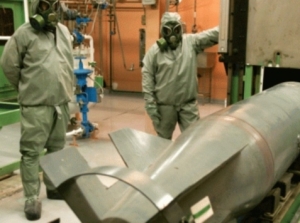
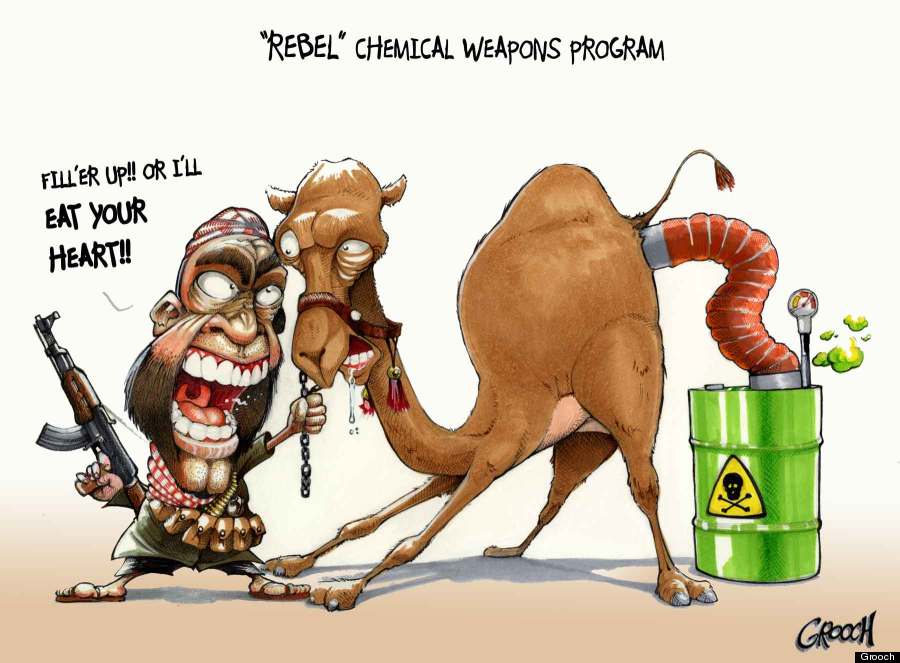
I know I was not the only one who thought it was very peculiar that as soon as Obama announced his “Red Line in the Sand” in Syria, which said that if Syria used chemical warfare, that would be crossing the “Red Line” and the U.S. would go to War with Syria, then days or weeks later a sarin gas attack? The videos of patients did not appear to have been from a Military Grade sarin gas (since the hops workers were handling the patients and did not get effected which is what would have happened if it had been military grade sarin) instead it appeared to be kitchen sink sarin like what was used in Japan. Even the delivery platform used looked like it was very akin to the rebels 5 gal water cooler plastic bottle rockets. They have another like this that uses 5 gal old propane tanks. They are launched from artillery. We know the Syrian governments delivery platform is much different and much more sophisticated. The Syrian regime sarin weapons atomizes the sarin and thus also why the wounded would need to be decontaminated prior to medical aide or transportation. – Shir Panjshir
 Sy Hersh has a long piece in the London Review of Books accusing the Obama Administration of cherry-picking intelligence to present its case that Bashar al-Assad launched the chemical weapons attack on August 21.
To be clear, Hersh does not say that Assad did not launch the attack. Nor does he say al-Nusra carried out the attack. Rather, he shows that:
- At some unidentified time since the beginning of the Civil War, Assad had discovered and neutralized wiretaps on his inner circle, leaving US intelligence blind to discussions happening among his top aides
- Sensors planted to detect any movement of Assad’s CW immediately had not been triggered by the August 21 attack
- By June, some intelligence entity had concluded that an Iraqi member of al-Nusra had the capability to manufacture sarin in quantity
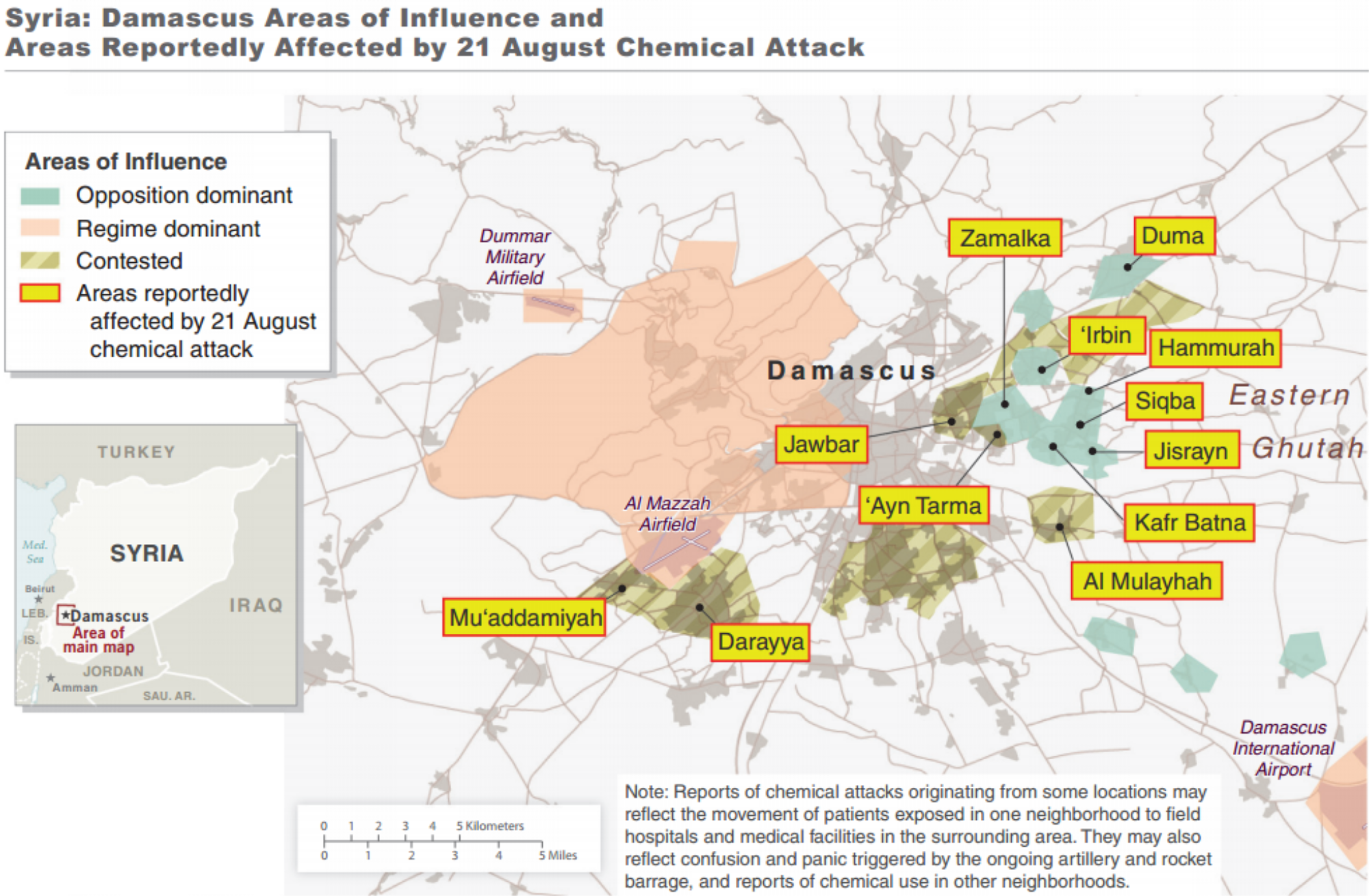 A lot of the story serves to establish that two days after the attack, the US had yet to respond to it, presumably because it did not have any intelligence Syria had launched the attack, in part because nothing had triggered the sensors that had worked in the past. To develop its intelligence on the attack days afterwards, the NSA performed key word searches on already-collected radio communications of lower level Syrian military figures.
‘There are literally thousands of tactical radio frequencies used by field units in Syria for mundane routine communications,’ he said, ‘and it would take a huge number of NSA cryptological technicians to listen in – and the useful return would be zilch.’ But the ‘chatter’ is routinely stored on computers. Once the scale of events on 21 August was understood, the NSA mounted a comprehensive effort to search for any links to the attack, sorting through the full archive of stored communications. A keyword or two would be selected and a filter would be employed to find relevant conversations. ‘What happened here is that the NSA intelligence weenies started with an event – the use of sarin – and reached to find chatter that might relate,’ the former official said. ‘This does not lead to a high confidence assessment, unless you start with high confidence that Bashar Assad ordered it, and began looking for anything that supports that belief.’ The cherry-picking was similar to the process used to justify the Iraq war.
 Ultimately, according to one of Hersh’s sources, they used intelligence collected in response tolast December’s Syrian exercise on CW as the basis for what the Syrians would have been doing in case of an attack.
The former senior intelligence official explained that the hunt for relevant chatter went back to the exercise detected the previous December, in which, as Obama later said to the public, the Syrian army mobilised chemical weapons personnel and distributed gas masks to its troops. The White House’s government assessment and Obama’s speech were not descriptions of the specific events leading up to the 21 August attack, but an account of the sequence the Syrian military would have followed for any chemical attack. ‘They put together a back story,’ the former official said, ‘and there are lots of different pieces and parts. The template they used was the template that goes back to December.’
 The White House presented this cherry-picked intelligence 9 days after the attack to a group of uncritical journalists (Hersh notes Jonathan Landay was excluded).
That’s the damning part of Hersh’s story on the intelligence used to support the Syrian warmongering (it is largely consistent with observations made at the time).
Hersh also describes how the NYT ignored the conclusions of MIT professor Theodore Postol, who determined at least some of the shells used in the attack were locally manufactured and had a much shorter range than publicly described.
Ultimately, though, Hersh’s biggest piece of news describes how someone — he doesn’t say who, but this part of his story relies on a senior intelligence consultant of unidentified nationality — sent Deputy DIA Director David Shedd a report on June 20 concluding that a former Iraqi CW expert with the capability of manufacturing sarin was operating in Eastern Ghouta.
An intelligence document issued in mid-summer dealt extensively with Ziyaad Tariq Ahmed, a chemical weapons expert formerly of the Iraqi military, who was said to have moved into Syria and to be operating in Eastern Ghouta. The consultant told me that Tariq had been identified ‘as an al-Nusra guy with a track record of making mustard gas in Iraq and someone who is implicated in making and using sarin’. He is regarded as a high-profile target by the American military.On 20 June a four-page top secret cable summarising what had been learned about al-Nusra’s nerve gas capabilities was forwarded to David R. Shedd, deputy director of the Defense Intelligence Agency. ‘What Shedd was briefed on was extensive and comprehensive,’ the consultant said. ‘It was not a bunch of “we believes”.’ He told me that the cable made no assessment as to whether the rebels or the Syrian army had initiated the attacks in March and April, but it did confirm previous reports that al-Nusra had the ability to acquire and use sarin.
 Though Hersh provided ODNI with the specific cable markings on this report, ODNI spokesperson Shawn Turner claimed to be unable to find it. Turner also issued a denial that suggests some other country came to this conclusion.
[N]o American intelligence agency, including the DIA, ‘assesses that the al-Nusra Front has succeeded in developing a capacity to manufacture sarin’.
“No American agency” of course specifically leaves open the possibility another intelligence agency has made such a conclusion — perhaps the British, who were in no rush to go to war in Syria in response to the August 21 attack.
In spite of Turner’s denial, Hersh quotes one of his main sources, a former senior intelligence officer, noting that the military had concluded the rebels had the ability to manufacture sarin, too.
So that’s it, the central claims in Hersh’s piece. He ends it not with certainty about who launched the attack, but with questions raised about Obama’s subsequent decision to walk away from his planned attack.
The administration’s distortion of the facts surrounding the sarin attack raises an unavoidable question: do we have the whole story of Obama’s willingness to walk away from his ‘red line’ threat to bomb Syria? He had claimed to have an iron-clad case but suddenly agreed to take the issue to Congress, and later to accept Assad’s offer to relinquish his chemical weapons. It appears possible that at some point he was directly confronted with contradictory information: evidence strong enough to persuade him to cancel his attack plan, and take the criticism sure to come from Republicans.
That’s what I’ve always looked to. What underlying intelligence would lead to these actions?
- Our European allies refusing to go to war based on the intelligence they had seen
- US refusal to provide specific intelligence on planned attacks in Syria to the Saudis
- Assad deciding to give up his CW stocks
- Obama giving the Russians a big win in Syria, followed by subsequent progress on an Iran deal
One potential underlying motivation for all these actions might be the discovery that al Qaeda has achieved our long-feared aim, the acquisition of CW, which it was using to stage an attack in an effort to get Americans (as one of Hersh’s sources describe) to “provid[e] close air support for al-Nusra,” and that it was doing so with some knowledge or even assistance from our Saudi allies.
Such a discovery certainly might lead allies to avoid empowering al-Nusra. It would explain both Assad’s incentive to expose himself to Israeli attacks by disarming his CW, in an effort to provide real deniability for any attacks going forward. And perhaps most crucially, it might explain why we would move away from our role in granting the Saudis decisive help in extending their hegemony over the region, and move towards shoring up Iran as a counter-balance.
That is, al-Nusra wielding CW with the tacit support of the Saudis might explain all subsequent actions. [Update: If al-Nusra has CW and the Saudis have not objected, it might lead to these actions whether or not they staged the August 21 attack.]
Which leads me to one other tiny detail in Hersh’s story, his source’s description of who pushed the quick conclusion that Assad was responsible.
‘The immediate assumption was that Assad had done it,’ the former senior intelligence official told me. ‘The new director of the CIA, [John] Brennan, jumped to that conclusion … drives to the White House and says: “Look at what I’ve got!” It was all verbal; they just waved the bloody shirt. There was a lot of political pressure to bring Obama to the table to help the rebels, and there was wishful thinking that this [tying Assad to the sarin attack] would force Obama’s hand: “This is the Zimmermann telegram of the Syrian rebellion and now Obama can react.” [my emphasis]
Now, this description of Brennan is a tell. He is and was by no means “the new director” of the CIA; by early September he had been in place for 6 months already. That he was perceived to be such by a “former senior intelligence official” might suggest the source is someone at CIA who lost out with Brennan’s ascendance, perhaps someone close to Mike Morell, who had been a candidate for the position (Morell left CIA on August 9).
That by no means means this person is wrong. But CIA officers and alumni who opposed Brennan’s nomination have long condemned his close ties to the Saudis, even claiming he thwarted investigations of al Qaeda while serving as Riyadh station chief in the 1990s, investigations which might have prevented 9/11. So while it is a subtle point, it is worth noting that Hersh’s sources point to Brennan as the source for the quick conclusion that the Saudis wanted us to reach, that Assad had launched the attack.
Hersh’s sources analogize this cherry-picked intelligence to the case for the Iraq War. Are they, with that, also pointing to someone who had been a close aide for George Tenet when he cherry-picked that intelligence?
So I have listed a few of the many sources you can read about this
Obama warns Syria amid rising concern over chemical weapons – Washinston post
Libyan rebel commander admits his fighters have al-Qaeda links – The Telegraph
Should We Fall Again for ‘Trust Me’? – ConsortiumNews Investigative Reports
The Risk from Distorting Intelligence – ConsortiumNews Investigative Reports
OFFICE OF THE DIRECTOR OF NATIONAL INTELLIGENCE – Statement by the Director of Public Affairs for the Director of National Intelligence Shawn Turner, on the intelligence related to the terrorist attack on the U.S. Consulate in Benghazi, Libya
To some, US case for Syrian gas attack, strike has too many holes – McClatchy D.C.
Following alleged sarin attack || Defense Minister: Assad used chemical weapons multiple times in Syria But Western experts are skeptical that nerve gas was used Wednesday, and describe other viable scenarios.
East Gota 29/08/2013 assembling some of the evidence obtained by the Commission inspection 1 – video
UN weapons inspectors to leave Syria a day early – The Gaurdian
Israel TV: Chemical weapons were fired by Assad’s brother’s unit – Israeli Times
‘IDF intercepted Syrian regime chatter on chemical attack’ – Israeli Times


